Four ways to find the part number
There are four paths to a part number: the vehicle's VIN, the number stamped on the part, the old box or invoice, and the photo. From most exact to least certain, the VIN pins down trim and engine; the photo is the emergency option. If none turns up, you search by part name and vehicle data.
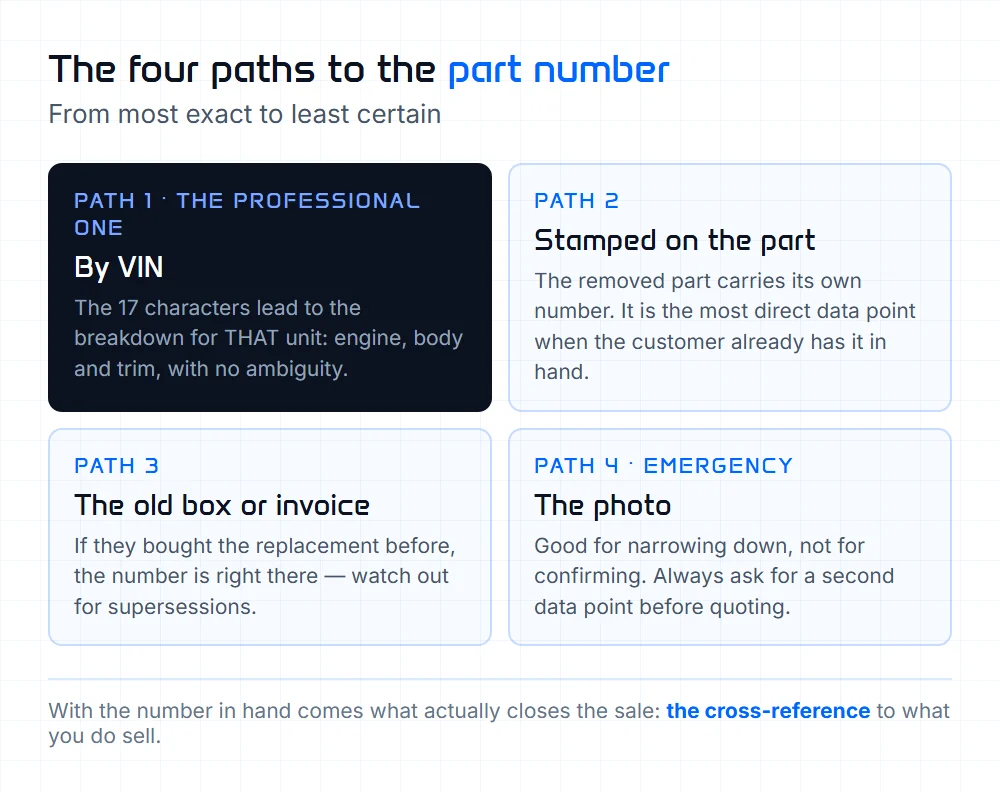
| Path | What you need | How exact it is | Watch out |
|---|---|---|---|
| 1. VIN | The vehicle's 17 characters | The most exact: it defines engine and trim | It almost never shows up: only 2.1% of requests carry one |
| 2. Stamped on the part | The old part in hand | Direct if legible | May be the automaker supplier's number |
| 3. Old box or invoice | The past purchase | Good, if still current | Supersessions: the number may have changed |
| 4. Photo | Both faces, something for scale, the vehicle | The least exact | It does not always tell similar sizes or connectors apart |
Path 1: by the vehicle VIN (the professional one)
The VIN has 17 characters and sits at the base of the windshield and on the driver's door frame. It encodes plant, year, engine and trim. With a catalog of applications (the brand's EPC or data with ACES structure) it gets you the exact number for that vehicle, with no guessing between trims.
It is the right path whenever the part changes by engine or equipment. The full guide: decoding the VIN to sell auto parts.
Want to see how Victoria quotes a part like this? Message us on WhatsApp and we show you live.
Message us on WhatsApp →Path 2: the number stamped on the part
Many parts carry the number stamped on them or on a label: alternators, ECUs, headlights, pumps, injectors. Before searching by vehicle, look at the part you are replacing: if the number is legible, the lookup is direct. Watch out: it may be the automaker supplier's number rather than the service number, and that is where the cross-reference comes in.
Path 3: the old box or invoice
The number from the last purchase is gold, with one trap: supersessions. Manufacturers replace numbers over time, so the one from three years ago may have been superseded. A good catalog follows the replacement chain to the current number instead of answering that it no longer exists.
Path 4: the photo (the emergency one)
With no VIN, no stamped number and no box, what is left is a clear photo of both faces of the part, with something for scale, plus which vehicle it came off. An experienced counter or a quoting tool that reads images identifies the part type and cross-references by application from there.
Given a photo with no name, the AI identifies the part and asks for whatever is missing, for example the side. A photo helps, but it does not always tell similar sizes or connectors apart.
What if none of the four turns up?
You search with the part name and the vehicle data: make, model, year and engine. An AI quoting tool understands everyday counter language and asks for what is missing, part by part, until only one option is left in the catalog. It is the most common case: almost nobody arrives with the number.
- Each part family needs different questions. A rotor, an engine mount, a suspension part and a clutch are not asked about the same way. The AI asks what it needs, like the guess-who game, and the less sure it is the more it asks, until a single part is left.
- The same part does not fit everyone. It changes by engine, automatic or manual transmission, air conditioning, 4x2, 4x4 or AWD drive, and by the country where the car was assembled. If the year or the engine is missing, it gets asked before quoting.
- Side and position are different numbers. The front left and the front right rotor are two numbers; if the position is missing, it gets asked. If they ask for "pads", front is assumed and rear is confirmed.
- Context builds up in the conversation. The customer says "radiator", then "Vento 2017", and the AI already understands the context and can also offer the coolant. With the vehicle set in the conversation, a part that does not exist for that engine is not made up.
- Voice notes work when the mechanic's hands are dirty. The note is transcribed and answered like a text.
More on how the counter talks in auto parts slang guide, and the step by step in how to identify the part your customer needs.
Which data works for what: VIN, plate, chassis, part number or photo
The VIN or chassis number identifies the exact version of the vehicle; the part number is the direct shortcut to the part; the photo helps recognize the type of part. With none of them, make, model, year, engine and the part name are enough. Plate and VIN are not used the same way in every country.
| Data | What it identifies | When it fits |
|---|---|---|
| VIN or chassis number | The exact vehicle: plant, year, engine and trim | When the part changes by engine or equipment |
| Part number | The exact part | When the customer has it; it gets crossed to the equivalent you sell |
| Make, model, year and engine | The application | The most common case, together with the part name |
| Photo | The type of part | When the customer does not know what it is called |
| Everyday name | The part, in counter words | Almost always: it is how most people ask |
| License plate | The vehicle, via the country's registry | In Chile, VIN and plate lookup is already live; in Mexico, VIN and plate we are working on |
What the data says: almost nobody brings the part number
At a real counter, at least 95 out of every 100 requests arrive with no part number, and 1 in 3 arrives with a photo. The VIN almost never appears. That is why the part number is a useful shortcut but cannot be the requirement: you have to be able to quote with what the customer does bring.
| Figure | What it means | Source and date |
|---|---|---|
| At least 95 out of 100 | Requests that arrive with no part number | Our own measurement: 57,681 requests over 20 months at a real counter, 2026 |
| 1 in 3 | Requests that arrive with a photo | Same measurement: 15,520 of 57,681 |
| 2.1% | Requests that carry a VIN | Same measurement: 1,225 of 57,681 |
| Two out of three | Arrive with text only: no number, no VIN, no photo. The median message is 18 characters, like "Chevy c2" | Same measurement |
| 1 in 7 | Messages that are a photo or a voice note | Our own measurement: 46,597 messages from 6 auto parts stores, September 6 to 12, 2026 |
The unit is the request, not the message: a customer sends several messages for a single part. "Brings a part number" is a ceiling, not a point percentage.
Once you have the number: the cross-reference
Having the original number is almost never the end of it: the counter sells its documented aftermarket equivalent. That jump is the cross-reference, and the rule is to answer only with crosses backed by the store's catalog. If there is no equivalent, neither the number nor the price is invented: it goes to a person.
Read auto parts cross-reference for the full method, and EPC catalogs to see how each brand organizes its numbers.
💡 In our measurements of a real counter, at least 95 out of every 100 requests arrive with no part number: most come in plain language or as a photo. That is why an AI quoting tool accepts all 4 paths and answers with the number, the price and the stock in one go.
Frequently asked questions
How do I find the part number for my car?
With the VIN: its 17 characters pin down plant, year, engine and trim, and a catalog with applications (the brand's EPC or data with ACES structure) gets you the exact part number for THAT vehicle.
Where is the part number on the part itself?
Stamped or on a label, depending on the part: alternators, ECUs, headlights, pumps and injectors usually carry one. If it is legible, the lookup is direct; if it is the automaker supplier's number, you have to cross-reference it to the service number.
What if the number I have no longer exists?
It was almost certainly replaced (a supersession). You follow the replacement chain to the current number and cross-reference from there to whatever equivalent you stock; answering "it does not exist anymore" without checking the chain is losing the sale.
Can I find the part from a photo alone?
Yes, as the emergency path: a clear photo of both faces, something for scale, and which vehicle it came off. An experienced counter or a quoting tool that reads images identifies the part type and cross-references by application.
What do I do if the customer does not know the part number?
That is the normal case: at least 95 out of every 100 requests arrive with no part number. You search with the part name and the vehicle data (make, model, year and engine). If something is missing, you ask before quoting, because the same part changes by engine, transmission, drive and side.
Which data do I need to look up a part: VIN, license plate, chassis number or part number?
The VIN or chassis number, which are the same thing, identifies the exact version of the vehicle. The part number is the shortcut to the part. If you have neither, make, model, year, engine and the part name are enough. VIN and plate lookup in Mexico is still in development; in Chile, VIN and plate lookup is already live.
Why does the same part have different numbers depending on the vehicle?
Because it changes by engine, automatic or manual transmission, air conditioning, 4x2, 4x4 or AWD drive, and by the country where the car was assembled. Manufacturers also share parts and number them differently, which is why cross-references exist.
How can a customer send the part: text, voice note, photo or video?
Victoria quotes from text, voice notes and photos. Video, not yet: if they send one, she passes it to a salesperson.